|
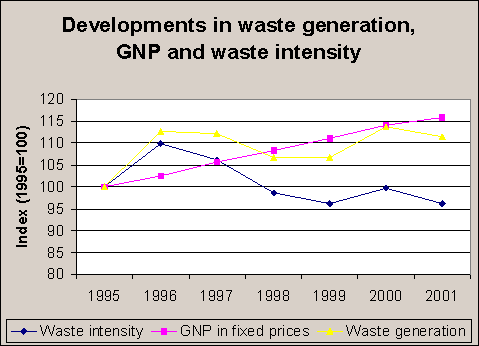
Waste Statistics 2002 7 New indicators for resource loss and environmental impactsUp to now, Denmark has been measuring its environmental efforts in waste arisings. As one of the few countries in the EU, Denmark is able to provide annual figures on treatment of waste and total waste generation in tonnes. A high recycling rate has typically been set as the target of successful efforts. The plan is to continue this focus on waste arisings, but to make sure that initiatives are founded on an improved decision basis that links the environmental problems to actual waste arisings. Denmark has therefore developed and calculated a number of new indicators providing information about the environmental and resource impact of waste. The new indicators show resource and energy consumption, as well as landfill requirements for a number of treatment options. To begin with indicators for 22 material types found in waste have been developed. The purpose of the new indicators is to create a better decision basis for waste treatment. The new indicators will be a help when making priorities and calculating whether recycling rather than incinerating a certain waste fraction represents a better choice seen from an environmental and resource perspective. It is not possible, however, to determine the degree to which waste prevention measures would be environmentally beneficial. For this purpose, the existing data basis is not yet sufficient. Waste arisings will still be used as an indicator of the efficiency of efforts within the waste area. As an indicator, waste arisings are simple and easy to use. However, waste arisings will no longer be the only indicator: they will be supplemented with calculations of resource loss in waste - from raw material extraction through manufacturing to recycling, incineration, or landfilling of the waste. The first versions of the new indicators will be published together with Waste Strategy 2005-2008. However, the full benefit of the new indicators will not be reaped until the indicators have been calculated for a number of years. 7.1 Waste arisings and economic growthA great challenge exists in decoupling the increase in waste arisings from economic growth. All sectors in society must contribute to solving the problem of increasing waste arisings. First of all, the goal is to make sure that the growth in waste arisings does not occur in step with economic growth. The figure shows that from 1995 to 1996 total waste arisings increased faster than economic growth. After having shown a fall, waste arisings increased once more from 1999 to 2000. This, however, is only true for total waste arisings. Waste generation is the result of the total number of activities in society. Total waste generation compared to gross national product (GNP) is an indicator of the waste intensity in society. Figure 19. Changes in waste generation compared to economic growth.
The graph shows the relative changes in gross national product at constant prices [26] (GNP), waste generation, as well as waste intensity, which shows the relationship between the relative changes in waste generation and the relative changes in GNP. As can be seen from the figure, waste intensity fell until 1999 (decoupling) and has since then been relatively constant. This means that since 1999 the growth in waste arisings has generally corresponded to the growth in GNP. Thus, trends do not seem to be going in the direction of decoupling. Rather, they are showing a relatively constant relationship between growth in waste arisings and economic growth. Since amounts of waste from a number of sectors are increasing, it is still important to work towards reducing waste. Projections show that waste arisings will continue to increase in future, unless efforts are made to prevent this. This is apparent from for example "Environment in the European Union at the turn of century" a report by the European Environment Agency. 7.2 New indicators for resource loss and environmental impactsWaste indicators for resource loss and landfill requirements have been developed and calculated for 22 waste materials. The indicators show the environmental benefit that can be gained from recycling or incinerating rather than landfilling a given waste fraction. This means that preparing the indicator involves calculating the resource and energy loss from landfilling of the entire waste fraction and comparing these figures with a new treatment situation in which a realistic amount of the fraction is either recycled or incinerated [27]. The indicators have been calculated on the basis of waste arisings in 2000. Projections of waste arisings have not been made. The indicators can be a help when prioritising efforts in relation to individual fractions, since they can indicate which treatment option is better from a resource and environmental perspective: recycling or incineration? In this way, the new indicators can help point out how to least impact the environment. Moreover, they are an important element when assessing the quality of Danish waste treatment. With the new indicators at hand, it is possible to select specific focus areas for future efforts. The indicators have now been calculated for 2002, and may serve as a basis for new initiatives on waste. However, before the implementation of concrete initiatives, a more thorough environmental and economic analysis will be carried out. The new indicators require extensive LCA[28] data, material-flow analyses, and complex calculations. The calculation of the indicators therefore entails a certain degree of uncertainty. From a critical review of the method and the data basis it has been concluded that the indicators clearly present a truer picture of actual environmental impacts than existing indicators based exclusively on waste arisings. However, the indicator for landfill requirement is extremely uncertain. Due to insufficient LCA data it has not been possible to calculate the indicators for all waste fractions. Moreover, indicator calculations do not include toxic effects, since there is no data in this area. It is therefore important to supplement the indicator values with a qualitative assessment of dangerous emissions from processes in the materials' lifecycle before any final decisions regarding the new initiatives are made. New treatment methods have been developed for the environmental contaminants in the waste fractions PVC and impregnated wood. However, LCA data is not available for these processes. Consequently, the methods have not been included in the calculated indicators. 7.3 DefinitionsFor each of the selected materials, 3 indicators have been calculated:
Resource consumption is stated in person reserves (PR). Person reserves are an indication of the quantity of the material in question available per person. (For non-renewable resources, the available quantity is calculated per person in the world. For renewable resources, however, the available quantity is calculated per person in the region.) Energy consumption is calculated in person equivalents (PE). Person equivalents correspond to the amount of energy (primary energy) consumed per person per year. Landfill requirements are likewise stated in person equivalents. In this case, a person equivalent corresponds to the amount landfilled per person per year. 7.4 Materials and treatment optionsThe indicators are based on waste amounts in 2000, and on the treatment applied that year. Waste amounts led to landfill, incineration, recycling, and reuse are shown in Figure 20. The figure shows that in 2000, large amounts of paper and cardboard, impregnated wood as well as plaster were landfilled. Paper and cardboard, wood, and organic domestic waste, as well as contributions from the many different plastic materials, represent the largest amounts led to incineration. The largest amounts recycled are represented by the materials concrete, tiles, asphalt (incl. reuse), paper and cardboard, and iron and steel. 7.5 Indicators for resource savingsFigure 21 shows the amount of resources saved from existing waste treatment compared to a situation in which all waste is landfilled. The resource savings have been divided into energy resources and other resources. The recycling of the different metals has especially contributed to the resource savings already achieved. Lead, tin, and zinc are not included in the figures, as LCA data on these materials are insufficient. However, it is estimated that resource savings for lead, tin, and zinc will be at a level with the other metals, since they are resources with relatively short supply perspectives. Paper, wood, and the six plastic fractions especially contribute to resource savings, since they replace energy-generating materials for electricity and heat production when incinerated. The building materials concrete, tiles, and asphalt have not been included in the figure, as they do not represent important resource savings: when recycled, concrete, tiles, and asphalt replace resources that already exist in plenty. Figure 22 shows the potential for improvement if a larger proportion of a given fraction, which today is incinerated or landfilled, is instead recycled. Thus this figure shows indicator values for how much more can be saved on resources by improving the existing treatment. A positive value indicates that an environmental benefit can be gained from resource saving by changing the present waste management into "optimised waste treatment" characterised by increased recycling rates. Calculations include an assessment of how much more waste it would be realistic to recycle. Paper, plastic (excl. PVC), aluminium, and copper represent significant potentials for further resource savings through an increased recycling rate. Wood represents potentials for resource savings through increased recycling at waste incineration plants. The figure moreover shows that there are no further resource savings to be gained from recycling larger amounts of organic domestic waste, automobile rubber, and oil than are recycled today. For PVC it is assumed that a larger proportion of waste PVC is landfilled out of consideration for the environment, whereby the indicator value for resource savings becomes negative. 7.6 Indicators for energy savingsFigure 21 shows the amount of resources saved from existing waste treatment compared to a situation in which all waste is landfilled. Energy has already been saved to a great extent from treating a majority of the materials suitable for incineration. This reflects that one of the significant elements of the existing waste management is incineration with energy recovery. The expansion of electricity-generating waste incinerations plants over the last decade is an important contributor to the energy savings already achieved. Electricity generation based on waste at waste incineration plants replaces energy generation based on natural gas and other fossil fuels. Figure 24 shows the potential for improvement if a larger proportion of a given fraction, which today is incinerated or landfilled, is instead recycled. Thus this figure shows indicator values for how much more can be saved on energy by improving the existing treatment. Figure 24 shows that there are further potentials for energy resources in waste. This means that energy resources can be gained from increased recycling of the waste fractions. However, this does not apply to organic domestic waste, PVC, and automobile rubber. Efforts to increase the recycling rate for aluminium and paper are a prerequisite to saving more energy resources. For most of the plastic materials, as well as for glass packaging, minor energy savings can be gained from an increased recycling rate in place of incineration. The great potential for further energy savings from treatment of waste wood is due to the fact that calculations are based on increased incineration in place of landfilling. 7.7 Indicators for landfill requirementsThe indicator values for landfill requirements are extremely uncertain. Figure 25 shows how much Danish landfill requirements have been reduced as a consequence of waste management in 2000 compared to a situation in which all waste is landfilled. The indicator value showing savings in landfill requirements indicates that the existing waste treatment prevents that large amounts of waste end up in landfills. Where possible, the indicator also includes the so-called "hidden material flows". Hidden material flows are included in data on extraction of coal, and partly also in data on extraction of metals. Thus, the process of extraction of new materials or energy in order to replace materials lost to landfilling or incineration involves landfilling of waste. For most of the metals the landfill requirement in connection with extraction of ore is significant. However, since data for the hidden material flows is insufficient, these have generally not been included in calculations. If the hidden material flows were included in all calculations, figures would show significant potentials for reducing landfill requirements for most of the metals by increasing the rate of recycling. Figure 24 shows the potential for improvement if a larger proportion of a given fraction, which today is incinerated or landfilled, is instead recycled. Thus this figure shows indicator values for how much more the total landfill requirement can be reduced by improving the existing treatment. Glass and aluminium represent significant potentials for reducing landfill requirements, since the incineration of glass that is not recycled generates slag which requires landfilling. Aluminium, in certain thicknesses typically found in household waste, is not incinerated, and therefore does not contribute to slag. For several of the materials there is an increased landfill requirement. The increase in amounts of concrete, tiles, and PVC requiring landfilling is due to the fact that the demand for an increased separation of contaminants in landfilled waste has been taken into consideration in the determination of future waste treatment. The demand for increased separation is in relation to the situation in 2000. There has been a change from recycling to landfilling of these fractions. Results should be interpreted with caution, since the indicators comprise many different types of waste which have not been weighted according to their potential environmental impacts. 7.8 The new indicators in summaryWaste treatment in 2000, involving 66 per cent recycling, 24 per cent incineration, and 10 per cent landfilling, resulted in significant savings in resource consumption for waste consisting of paper and cardboard, wood, and the metals aluminium, iron and steel, as well as copper. Significant energy savings have been achieved from existing waste treatment of paper and cardboard, wood, PE plastic, aluminium, and iron and steel. Savings in landfill requirements from existing waste treatment cover almost all waste fractions, excluding impregnated wood, PVC, and sheet glass. The most important potentials for further savings in resource and energy consumption are in metals, paper, and plastic (excl. PVC). The greatest potentials for further savings in landfill requirements are in glass packaging and aluminium. 7.9 ConclusionThe development and calculation of the new indicators marks the onset of a valuable process. A process that will provide greater and more detailed knowledge on the environmental impacts of waste. The indicators contribute to a better foundation for making the right decisions in the waste area This is only the beginning of the process, and some years will have to pass before the indicators can serve as a well-developed and comprehensive tool for making priorities in regard to waste initiatives. However, this is the first step towards developing the proper tool, which will ensure better quality in Danish waste treatment. In combination with other knowledge on waste and socioeconomic calculations, the indicators are a first step towards a tool to finding the most cost-effective solution for the environment. New indicators for additional environmental effects must be developed in future, and the data basis must be enhanced. Already calculated indicators must be updated on a regular basis to help ensure that the most environmentally beneficial waste treatments are used. Footnotes[26] Constant prices are annual prices adjusted for changes in prices and thus express real growth. [27] In other words, the indicator values show the savings gained from using the individual treatment options compared to the option of landfilling the entire waste fraction. [28] LCA: lifecycle assessment
|