|
| Forside | | Indhold | | Forrige | | Næste |
Behandlingsteknologier for batterier - Fase 2
Summary and conclusions
Summary
The purpose was to test a method of treatment of used alkaline manganese batteries and zinc-carbon batteries and to examine the contents of mercury in these batteries collected in
Denmark.
Test of method for processing batteries
In pilot scale we have developed and constructed a pyrolysis plant for batteries.
After a test phase, where 7 initial tests were carried out (test nos. 1-7) and the plant was continuously adjusted, the final test series was started (test nos. 8-14).
A total of 518 kgs of spent alkaline manganese batteries and zinc-carbon batteries, received at Kommunekemi in 2002, were used for the tests. The batteries were taken at random
from four different drums, and it was ensured that no button cells were among the spent batteries.
The tests were carried out by pyrolysis of the batteries in a reactor. Pyrolysis is heating without addition of oxygen. The heating was carried out by conducting warm flue gas, poor in
oxygen (app. 2% O2) from a gas oil burner through the pyrolysator. In this way the batteries were heated to 550-600 °C.
During the heating, plastic and other organic material from the batteries are transformed and the mercury evaporates. It has been found that app. 98% of the mercury content is removed
from the batteries during the pyrolysis. After pyrolysis, two possibilities as regards the further processing remain:
- Without further treatment the pyrolysed batteries can be sent for processing at zinc works or at steel works
- The pyrolysed batteries can be separated into fractions to be sent to different processing companies.
By processing of unfractioned batteries, the degree of recycling is not as high as if the batteries are separated into fractions. In zinc or steel works it is not possible to recycle both zinc,
iron and manganese.
To examine the possibility of separating into fractions, after pyrolysis the batteries are subdivided into a powder fraction and a metal fraction. Additionally the metal fraction is subdivided
into an iron fraction and a non-iron fraction. Separation was not as good as it should have been in the shredding equipment used, but it could be improved easily in a full-scale plant.
Contents of all fractions were analysed. From this analysis it was demonstrated that the powder fraction and the non-iron fraction primarily consist of zinc and manganese. The mercury
content is on average under 5 mg/kg and these fractions can thus be sent for processing with companies, specialized in processing zinc and manganese. Zinc and manganese make up
app. 40% of the original battery weight before pyrolysis.
The carbon content, app. 3% of the original battery weight, can be utilized as energy supplement by thermal processing of zinc and manganese.
The iron fraction makes up app. 20% of the original battery weight before pyrolysis. The iron can be immediately recycled in the steel industry, as the iron is only oxidized (corroded) to
a limited degree because of the low oxygen content during the pyrolysis.
The rate of recycling is thus at app. 60% of the original battery weight. Additionally 3% of the weight can be utilized as energy.
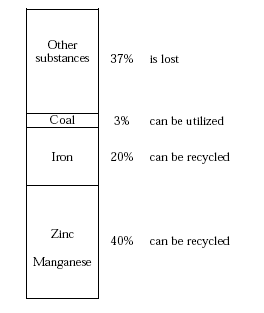
Figure 1. Degree of recycling for alkaline manganese batteries and zinc-carbon batteries. The figure indicates the percentage by weight of the battery that can be recycled and utilized.
Other substances include salts, water, plastic and oxygen.
Mercury content in spent batteries
The average mercury content of spent batteries has been calculated by determining the mercury content in the pyrolysis gas and comparing this to the quantity of batteries. To this is
added the mercury content of the remaining fractions after the pyrolysis.
The average mercury content in the 518 kgs of spent batteries has been determined as 117±11 mg Hg per kilogramme of batteries.
If above mercury content is compared to results from four companies in Europe that process spent alkaline manganese batteries and zinc-carbon batteries, three of these state an
average content of app. 200 mg Hg per kilogramme of batteries, while the fourth company states a content of no less than 1,500 mg Hg per kilogramme of batteries.
The very high value from the latter company is obviously due to the fact that the button cells have not been separated before the treatment.
With the other three companies the values are somewhat higher than the value in this examination. The high value may be due to existence of button cells in the treated batteries.
Conclusions
- By using this test method - pyrolysis and subsequent sparation into fractions – it is possible to carry out pre-treatment of the batteries in Denmark. This allows for recycling of iron, zinc
and manganese making up app. 60% of the battery weight.
- Plastic and other organic material, problematic in connection with the recycling of the batteries, can be removed during pyrolysis.
- 98% of the mercury content in the batteries can likewise be removed during pyrolysis.
The batteries used in the examination had a mercury content of 117±11 mg/kg. This is lower than the result, stated by battery processing companies in Europe.
| Forside | | Indhold | | Forrige | | Næste | | Top |
|