|
| Forside | | Indhold | | Forrige | | Næste |
Miljøinformation i produktkæden
Summary and conclusions
This project is called "Environmental Information in the Product Chain" and it demonstrates that it possible to prepare and communicate product-oriented environmental information reasonably easily in a
product chain with pigmeat. The Danish slaughterhouse TiCan and 10 farms supplying pigs for slaughter to TiCan participated in the project.
An environmental product declaration for the business-to-business market was prepared (table 1). Key figures for the following environmental impact categories are included: global warming, acidification,
nutrient enrichment and land use.
Table 1. Environmental product declaration for fresh, unspecified pigmeat ex slaughterhouse (TiCan) in 2003
| |
Global warming |
Acidification |
Nutrient enrichment |
Land use |
| kg CO2 eq./kg |
g SO2 eq./kg |
g NO3 eq./kg |
m2year/kg |
| Pigmeat ex slaughterhouse |
3.63 |
50.1 |
243 |
8.12 |
| Of this the pig production (farms) |
3.35 |
49.8 |
242 |
8.12 |
| Of this the slaughterhouse |
0.28 |
0.3 |
1 |
0 |
There is a considerable variation between the farms in the environmental impacts per kg pigmeat produced (figure 1). The most effective farms have impact figures 15-20 % below the average. The least
effective farms have impact figures 20-35 % below the average. Farms with low impact figures in one impact category in general also have low figures in the other impact categories – and vice versa.
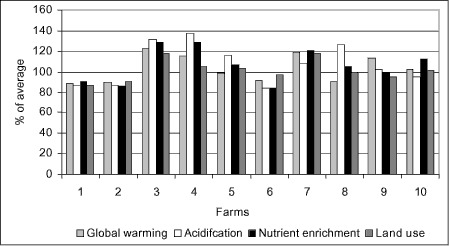
Figure 1. Variation in environmental impacts per kg pigmeat for 10 farms with pig production, relative figures in relation to a weighted average
Emissions of nitrous oxide (N2O) are the most important contributors to global warming from production of pigs (52 % of the total emission of greenhouse gasses). Losses of ammonia contribute on average
83 % of the total acidification. Leaching of nitrate contributes on average 51 % of the total contribution to nutrient enrichment. Ammonia contributes 34 %.
The consumption of feed per kg pigmeat produced is the most important factor concerning the size of the environmental impact figures and the differences between the farms. Improved utilization of feed
improves the figures for all four impact categories. It is estimated, that an improved utilization of feed of 12 %, reduces losses of ammonia from stables by 80 % and utilization of the slurry for production of
biogas can improve the environmental product declaration for pigmeat by 20-30 % for all four impact categories.
| Forside | | Indhold | | Forrige | | Næste | | Top |
Version 1.0 August 2005, © Miljøstyrelsen.
|